In northwest Madagascar’s Ankivonjy MPA, coastal fishers share their coral reef stories.
The Ankivonjy Marine Protected Area (MPA), near Nosy Be, in northwest Madagascar, is surrounded by sparkling turquoise waters, palm-fringed beaches and towering ancient volcanoes. Madagascar is home to 2% of the world’s coral reefs, which are among the most extensive, structurally varied, and biologically diverse in the Western Indian Ocean. These magnificent corals support over one thousand species of reef fish alongside 2,500 marine invertebrates.
Ankivonjy is a critical nesting and feeding ground for the iconic and critically endangered hawksbill turtle. It is globally recognised by the IUCN as a Category V Protected Landscape/Seascape. The Wildlife Conservation Society (WCS), Madagascar, as the National Technical Facilitator of the GEF 7 Coral Reef Rescue Project, is working with local communities and the newly formed National Hub to ensure the survival of the climate-resilient coral reefs here and to conserve this area of outstanding marine importance.
The designation of Ankivonjy MPA began in 2010 with extensive community engagement. This participatory approach continues to this day, ensuring effective and inclusive management of this vital ecosystem.
In this coastal country, fishing has been a way of life for generations. Fishing and related activities support nearly 1.5 million people across the island. In September 2025, the GEF 7 CRR project led a site visit to Ankivonjy with coastal fishers as part of the ongoing community involvement in conserving the reef.
At this workshop, the fishing community highlighted the importance of the reef and the visible impact of climate change. Marcel and Khaled, from the local Comité de Contrôle et de Surveillance in Marotogny, shared their insights with us.
"We see four clear links between our reef and our lives. First, the coral reef is the habitat for fish, octopus, and lobsters. Second, fish come to the reef as a refuge when currents and predators are strong. Third, the reef is also food: many fish feed directly on what grows there. And fourth, the reef protects our coastlines and beaches from waves.
For pressures and threats, we notice climate change through stronger winds and waves and through "ensablement" (sand shifting and smothering parts of the reef). We also recognize the impact of inappropriate fishing gear: filet kaokobe (or bamoloko), filet jarifa, and small spearguns (antsiraby). In Ankivonjy, coral health is mostly good, with less bleaching than before except near three villages: Ankatafa, Mangirankiragna, and Marotogny, where the corals have struggled.
Our conclusion is simple: without the reef, there are no reef fish, no octopus, and no lobsters. These are our main food sources."
Marcel and Khaled are local Community Surveillance Agents (CCS). These agents are volunteers chosen by the community who patrol and monitor fishing rules, help prevent illegal gear/use, report incidents, and support MPA/MLLA management with basic data and awareness.
The Wildlife Conservation Society (WCS) Madagascar team highlighted the value of this visit with the president of the fishermen’s association in Ankivonjy and around 7 fishermen. Morgane Dierkens, focal point of the GEF CRR Project for WCS Madagascar, described the output from these meetings.
“The coastal community spoke with precision and care, pointing out how the colors of the reefs have changed, how fishing grounds have shifted, how the seasons no longer follow the same rhythm. They see the signs of human pressures and the fingerprints of a changing climate in their daily lives.”
Morgane added,
“From these conversations, we gathered precious traditional knowledge, insights passed down through generations, that will help guide the way we care for and manage these fragile ecosystems. The fishers didn’t just share facts; they shared their perspective on the main pressures, their memories of abundance, and their hopes for future generations to be able to benefit the reef resources. For them, the reefs are not just part of the sea. They are a source of food, a foundation for their livelihoods, and a living storehouse of biodiversity. As they say: ‘No reef, no fish.”
Following the national workshop and field visit, the WCS team and project stakeholders will now work side by side to weave local knowledge of coastal communities and recommendations into Madagascar’s National Action Plan for Coral Reef Conservation. However, despite the enthusiasm of all the partners, the project team and the National Hub face extensive logistical challenges on the ground.
Madagascar is the fourth-largest island in the world, with approximately 5,000km of coastline and is surrounded by an Exclusive Economic Zone of approximately. 1.2 million km², more than double the land mass. Travelling across this biodiverse island presents numerous logistical challenges, as seen by the PMU team recently.
With few paved roads, even short trips by car or bus can take hours — often on crowded vehicles packed with people and goods. Combined with expensive domestic air travel, these challenges make it difficult for the National Hub team to meet regularly and visit key coral conservation areas.
Despite these logistical challenges, the project is hopeful that the National Action Plan will be drafted and finalised within the coming year and will continue to support protection for the climate-resilient reefs. While the GEF 7 Coral Reef Rescue Project targets resilient reefs as a starting point, its outcomes—including the National Action Plan—will serve as a foundation for expanding coral reef conservation efforts across other areas of Madagascar.
Alongside supporting on-the-ground community engagement, establishing the National Hub and preparing the National Action Plan in Madagascar, WCS has also strengthened their relationships and contributions to the Madagascar Coral Reef Network (MCRN) to support a revitalized national effort for coral reef conservation.
The Network has established a new coordinating body and agreed on priorities, including the production of an updated national coral bleaching status report. WCS will work alongside government agencies, research institutes, and conservation NGOs to gather and standardise data, build capacity in reef monitoring, and ensure a coordinated approach to reef protection.
Whether through the voices of coastal fishers in Ankivonjy or through collaborating strongly with other coral reef conservation actors, WCS and the GEF 7 Coral Reef Rescue Project are ensuring that knowledge, both traditional and scientific, continues to guide the protection of Madagascar’s precious reefs.
About the project
The Coral Reef Rescue Project is a US$7m initiative funded by the Global Environment Facility to build capacity and solutions that ensure the long-term survival of climate refuge coral reef ecosystems and the communities that depend on them. The project is implemented by the World Wildlife Fund and executed by The University of Queensland in partnership with Yayasan Reef Check Indonesia, Wildlife Conservation Society, Marine Parks and Reserves Tanzania and Palawan Council for Sustainable Development Philippines.
Contact
For more information contact GEF CRR Project Manager Jennifer Dunn: jennifer.dunn@uq.edu.au
Words by Aoife O’ Mahony
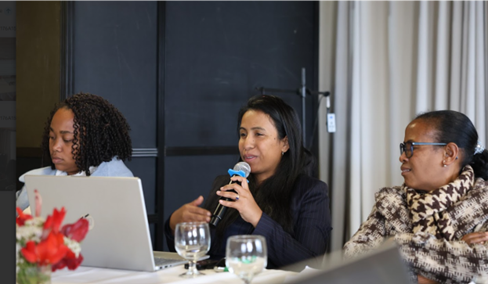
Tahiry Rakoto, focal point of the GEF CRR Project in the Ministry of Environment and Sustainable Development presenting the work to date.
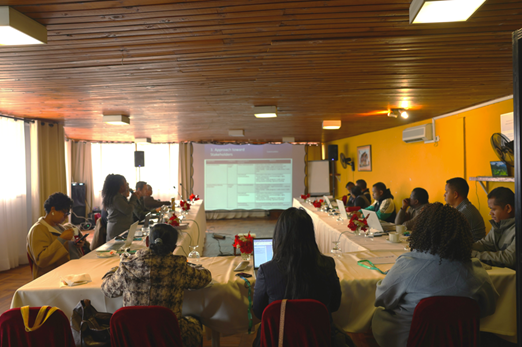
Participants in the national workshop with the GEF 7 Coral Reef Project Team and local stakeholders in Madagascar.